Route Map

Saturday, 23 April 2011

Hairy legs and bat sandwiches


We had a hectic start to 2011 and spent most of January in Cambodia, though posting this in April it already feels like light years ago. Our most vivid memories are trekking for three days including a 55km day trek, through a jungle where all the trees had spikes, swimming in three secret waterfalls, jumping off of 12 metre rocks into streams and eating delicacies such as tarantula, stick insect and bat to name but a few (well, Andy did and Alex filmed it):


We started in Siem Reap, in a hostel (my arse) recommended by our lovely friend Smeeta, who 'roughed it' here a couple of years earlier. How she survived the indoor heated pool, balcony, bar, pool tables and terrifying private cinema is beyond us. The town itself was touristy but very sweet, with some fantastic Khmer cuisine and the cheapest beer so far on our travels ($0.75 per pint). Outside the town we did the obligatory temple tour in Angkor, the most famous temple region in Cambodia. Ta Prohm was pretty eerie as the trees seemed to merge with the temple to create an awe inspiring sight.


The Bayon’ with four Buddhist faces watching every direction was also a great work of art. Angkor Wat was also very peaceful and calming and showed a great deal of work had gone into it. We were lucky enough (or lazy enough) to catch this temple at sunset rather than sunrise, and had it almost to ourselves, seeing it as it was meant to be - serene and quiet, rather than flashing with the bulbs of a thousand cameras.


After our intense temple tour we decided to relax our aching feet with the latest fad - a fish foot spa. Alex, having ticklish feet, found it a little trying:


We were also very fortunate whilst in Siem Reap to meet an Australian lady named Deborah on our flight into Cambodia. she was a strong willed, good hearted and enigmatic lady who was setting up a school for impoverished village children just outside Siem Reap. Needless to say, we got on very well and arranged to visit the school for a day. The day was fantastic and alllowed us a real insight into the lives of these children. They displayed a keeness to learn that was unlike what I had been used to. They also had developed motor skills that were unbelievable for their age. We had a brilliant time and the visit caused a great deal of thinking about future plans. Ultimately though, despite the temptation to 'do good', we thought that the best thing for Cambodia would actually be to leave it alone from western influences and allow it to develop naturally.

The existing village school, during an Art lesson:

From Siem Reap we took the bus down South to Phnom Penh, the capital, and stayed for a day to get our Laos visas. With only 24 hours there we did manage to see the creepy S21 museum and the Killing Fields, and were glad to leave after that. Then we were back on the bus up to Kratie with the intention of going to Ratanikiri in the North of Cambodia. However, fate struck as our bus overheated and as we stood baking by the hot roadside, it was clear that the bus was not going anywhere soon. Another bus pulled over after about ten minutes and we saw a few locals make the swap, so we looked at each other and quickly decided to take a punt. Three hours later we were in Mondulkiri ‘the wild east’ of Cambodia. It was a dusty windswept place more reminiscent of the Wild West, that did not see many visitors. After a well earned rest we set off the following day on what was to be our hardest trek to date.
On our first day we meet up with our guide, Hong, a local ‘Pnong’ tribesman who lived from the jungle and allowed us a fascinating and rewarding insight into a historic and sadly, dying way of life (can people be classified as endangered? If not they should). On our first day we walked 50k to his village, that’s right, 50k - believe it Ian! We were knackered and after 48km I turned to the third member of our group, a chain-smoking Irish weed addict named Martin who had brought nothing on the trek with him except a box of 200 ciggies and some hand santizer, and said, "I'm done" (or words to that effect) "what I would give for a cold beer." To our amazement, Hong invited us into a little dusty isolated hut just outside his village. It was an offie, and we probably bought more beer that night that they had sold in the last year. It was with great pleasure that we later were invited into Hong's home, built with his own hands from bamboo and elephant grass, containing only 2 wooden platforms and a fire, no chimney, and lots and lots of children and animals.

Hong's home:
Hong's family (mother-in-law in the foreground, with his wife and children behind):
Spending the night there was both disturbing and fascinating. We went to sleep with the entire family staring at us, and woke up with them still staring at us. Alex decamped in the morning to play with the kids, and got to know them a little. Pnong tradition is that girls are not given names at birth, and Hong's three daughters were thus known as 'Ian', 'Mian' and 'Nian' which roughly translates as 'First', 'Second' and 'Third'.

Hong's daughter Ian ('First'), a real sweety:
Next day we trekked through dense forest, stopping for lunch at a secret waterfall unvisited before by white people, where there was a cliff jump over the falls. Hong's safety briefing was, exactly that - brief. If we jumped, it seemed, a few feet too far left or not far enough out, we would die. Otherwise we were fine. As it turns out it was awesome fun.


That evening, we met Hong's 80 year old uncle whose name sounded like 'Pork Loin', who still thatched his own roof and walked two hours a day to fetch water. He had never eaten bread, drunk coffee or seen a white person before, despite being the oldest person we saw in Cambodia. He lived in a small house which he had built himself in the middle of the forest hours walk from any other humans. He grew vegetables to live from and a mountain of the harshest tobacco to smoke. He spoke a language called Hmong that has no written form, and had served as a latrine cleaner for the Khmer Rouge. He chose to live alone since his wife died, and meeting him was an amazing privilege - not only because of his way of life, but because he was probably one of the oldest survivors still living from the Khmer Rouge regime.

Pork Loin outside his home:


The last day of our trek we returned to Hong's village, stopping at a different waterfall. Our food had largely run out by now, but Hong didn't seem to worry. (Here Alex has taken over the script). No he didn't - as about half an hour away from the river we passed through a bamboo forest. Suddenly Hong stopped and listened, then showed us where some little bats had made their day-nest inside a wedge of bamboo. We could just see the little things through the small hole they had climbed in through. Hong seemed very excited and quickly whipping his knife out, chopped the bamboo off, leaving the segment which the bats were in, then stuffed the hole up with grass. He then said 'bat is my favourite'. I thought he meant animal. He didn't. What happened next I am still trying to forget, and forgive Andy for participating in. I did think of rescuing them, I really did, but Hong had a machete and I was a tad frightened that letting his lunch escape might anger him.

Hong 'preparing' lunch:
If anyone is curious as to how to prepare bat (by the way. it's Andy again), I'll let you in to a secret Pnong recipe:
1) Crush the bats skull between your thumb and forefinger
2) Skewer the remaining bat and roast it over a freshly made fire
3) Once crispy, (you will know this as the wings have been fully burnt away), remove bat from the heat.
4) Using a bamboo segment and a stick as a sort of pestle and mortar, crush the bats together with some jungle roots, (salt is optional).
5) Serve and enjoy!

Altogether it was an experience we will treasure, and never forget. At the time we didn't fully appreciate it, but we realise now we were very, very lucky to spend time with such a wonderful people who still live wholly reliant on nature - as close to Avatar as I think you could ever get.

Just to finish, Hong told us a wonderful story of how he had taken Gordon Ramsey to his village and showed him how to collect food from the jungle and how he prepared it - part of a forthcoming television show in the UK apparently though we can't remember what it is called. After the filming Ramsey offered to take Hong up in his Helicopter. Hong refused as he had no money to pay with, but after Ramsey explained it was a gift, he accepted and told us with bulging eyes how he had seen his jungle from the air - all the trees he knew, all the forest he lived in. It almost makes us cry typing it.

The rest of our trip up to the land crossing with Laos was largely uneventful and uncomfortable, but it did not matter as we had such great memories to take with us.

Tuesday, 4 January 2011

Cabin Fever in Kalimantan

We’re currently writing this from the luxury of shiny happy Singapore about 10 days after the last post was written, so our experience in East Kalimantan has had a chance to sink in. First thoughts are: how on earth did we put up with it and have we got fleas in our baggage? Second thoughts are, actually that was quite good fun, and although it had its ups and downs, it was definitely an extraordinary adventure that fell beyond the limits of the normal traveller routes, proven by the facts that there were only 2 pages in our Lonely Planet guide dedicated to Kalimantan and that we were, for about a week, the only whites in the village.


Despite East Kalimantan being a chunk of the earth that tourism seems to have ignored, we arrived late at night in the noisy, dual-carriagewayed city of Balikpapan to discover that all the guesthouses, hotels and B&Bs were fully booked by local Indonesians. Luckily our taxi driver Yuri was helpful and patient and spent about an hour driving us around the city to enquire at all the various lodgings. At last we were shown two available rooms – one had excrement on the walls and the other had a bin outside which had exploded, several days ago. I think even the roaches had forgone those, so we resigned ourselves to either asking our driver to stay with him, or checking in at the most expensive hotel in town. Then without warning we stumbled upon the Fortuna Hotel – it was cheap, it was open, but most importantly it was CLEAN!!! Really clean – with fresh sheets, white walls and shiny tiles in the bathroom!! I know it must sound like we go on about cleanliness a lot, but seriously we will never take it for granted ever again, especially after having to wash in this bathroom in East Kalimantan’s capital Samarinda:

The next day we investigated what there was to do here and found that the main tourist draw in East Kalimantan was to take a river tour up the mighty Mahakam river, on the way visiting the rainforest and seeing some traditional villages belonging to the indigenous Dayak tribe. This sounded perfect, so we found ourselves a guide and two days later arrived at the port in Samarinda and looked around for our houseboat, on which we were to spend the next two days as we travelled upriver. Somehow or other (mainly thanks to a rich ex-pat’s website) we got the idea that this would be like a pretty little canal boat in the UK. Our boat was a bit larger than that, about 20 tonnes larger, and about 200 other people were also getting on.


Above: our houseboat
Funnier still was when we saw our ‘room’:

Our bed space was about 2’ by 6’ each, with a dirty mattress each to sleep on, and complete strangers to sleep beside. We were fairly lucky – we got a chain smoker on one side and a lady with a baby on the other.


As the boat moved away from the port we got our new sleeping bags out and bedded down on our mattresses, in the process probably ingraining the idea in all the local’s heads that the British are extremely fussy and preoccupied with cleanliness, as we took our mattresses outside and sprayed them with flea killer, and thereafter tried our utmost not to make direct contact with the fabric. We also made the best of what space we had, with a games corner, a strung-up washing line and a larder (mostly containing Tim Tams, delicious biscuits like Penguins only better). Then we noticed everyone else was doing the same in their own fashion. Ladies were hanging makeshift costs from the ceiling, and getting out pre-prepared picnic baskets, kids were using the gangway as a running circuit and others were getting in their pyjamas and snuggling down for the day. It actually started to feel really homely, and when a few people gave us some tentative smiles we started to realise that this was actually a real, local experience and one we were lucky to join in! We also quickly realised after we ventured downstairs that we were in ‘First Class’; some poor souls had seats downstairs, where there were no mattresses, only a plastic mat to sit on, no walls, an unbelievably loud motor engine, all squished in between the cargo – boxes containing everything from chillies to chickens, motorbikes, bicycles and coils of steel.


Next to them was the kitchen, a small table to eat on, and next to the kitchen – right next to the kitchen - were the bathrooms. Imagine a wooden cell about 2 foot square, with a hole and a hose. It was a whole new level of basic, and we didn’t realise until we were well underway that in Kalimantan there is no such thing as ‘sewage treatment’ – everything goes straight into the river, from the boat, the villages and the factories. Andy described the water as ‘brown with white bits’ which made me laugh until I realised this was what we were expected to wash in and drink for the next two weeks of our trip.

Bottoms up!
We arrived safely at the end of the river at a village called Long Bagun, on Christmas Day. After being shown around the village we were a little disappointed that many of the Dayak traditions were a shadow of the past. The great longhouse was empty and only used for the odd ceremonial occasion, sadly not including Christmas, and mobile phones shops and plasma screens seemed to have replaced singing, dancing and storytelling. However, the village still had some unique charms. The children were lovely, bursting with energy and led us a merry race around the village on their bikes:

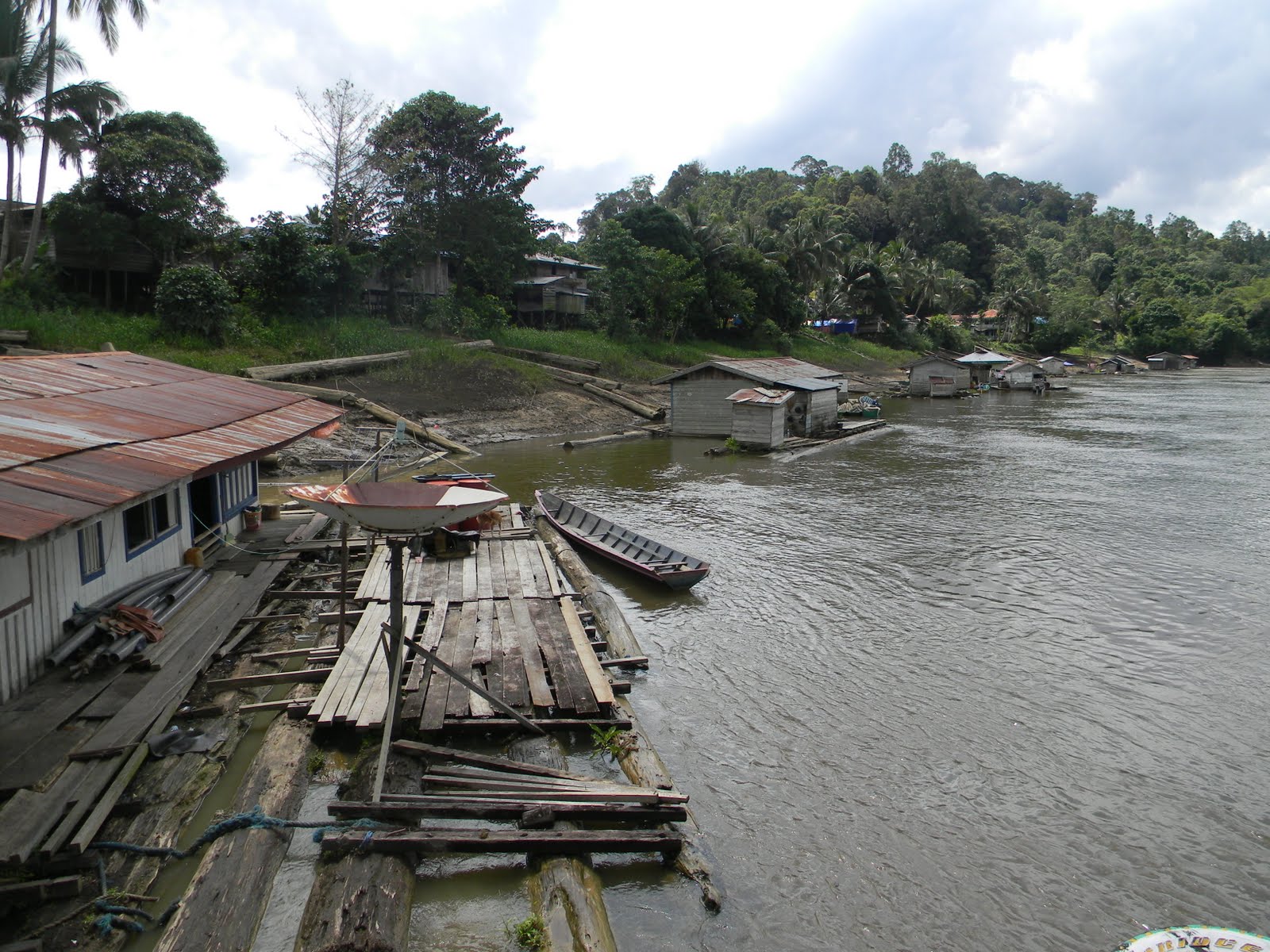
The village also had many floating houses - basically wooden houses strapped to massive logs, which were designed to rise and fall with the level of the river. Apparently these were favoured over normal land-based houses as if you fell out with your neighbour you could simply float downstream. Genius!

We ate a simple Christmas Dinner of boiled rice, boiled veg and boiled fish, and for the first time really appreciated the English roast dinner, a concept which we couldn't make the Indonesians understand. I think at that point both of us would have drunk some unboiled water in return for a Yorkshire pudding.

Later the same day we took a short canoe trip across to a neighbouring village to see another longhouse, sadly also out of use. But on our way we passed a small Catholic church where a Christmas service was taking place. We were immediately invited inside and listened to the wonderful singing, until the end when everyone turned around and wished us 'Merry Christmas' in English. I think we both had tears in our eyes as they were so welcoming, warm and friendly and at that point we missed home terribly. But we weren't allowed to feel sad for long as a lovely girl called Lia invited us back to her home for some tea and cakes, and to meet her family. At the grand age of 22 she was a retired model from Sulawesi with three children. She was spending Christmas with her husband's family, and here we found our first trace of true Dayak tradition, as her great-grandmother-in-law was over 100 and sported the elongated earlobes which Dayak women used to wear - they nearly reached to her shoulders! (It was too rude to take a picture so we haven't got one to show).

With Lia on Christmas Day
On Boxing Day we took a much longer canoe journey upriver, which was really exciting as we wound along the bendy river, scooting over fallen logs and listening to the screeching of the birds in the treetops above. The canoe (pictured below) had a stick for steering and no daggerboard, which meant that the slightest movement nearly pitched us and our belongings into the river. Luckily we had a highly experienced Dayak guide with us called Thomas, who with some sort of magical instinct could tell where the water was safe and later, when we stopped at a rocky riverbank, built us a simple shelter with his machete. It occured to me that we had allowed ourselves to be driven into the middle of nowhere by a man wielding a giant knife, but fortunately Thomas was lovely, if possibly the most talkative man in Indonesia, with not a word of English in his vocabulary. And our Indonesian didn't extend much beyond 'how much is that' and 'no more rice, please'.

After watching Thomas setup our camp for the night, we ventured on a short trek into the rainforest. Here we were again disappointed, as the forest we were walking through wasn't true rainforest, but secondary, recovering rainforest as the land had been previously cleared years ago by the locals for rice planting. In fact on our canoe journey we saw whole swathes of forest which had been cut and burned to make way for paddy fields, and although on a local scale this is sustainable, on top of this scores of logging, coal and gold-mining companies are clearing the forest at such a rate that 20 years ago you could arrive in Sanmarinda on the coast and be within virgin rainforest within half an hour, whereas we had travelled for nearly 3 days into the heart of Kalimantan and even here it was impossible to find. The reality that Greenpeace haven't got it all covered, and that today's children may not have any real rainforest left to see in this part of the world, was really upsetting. Apparently Malaysian Borneo is far more protected than Kalimantan, but here it seemed to be a free-for-all, and even worse the local Dayaks, in return for money to buy modern conveniences, help the large corporations to discover new areas of virgin forest to chop down. Kalimantan seemed to us to represent one of the world's greatest resource supermarkets and also one of the world's biggest rubbish dumps. For such a beautiful, spellbinding place with such a lovely people this is a real tragedy. And on this realisation we felt we'd seen enough. Although there were many more 'traditional' vilages awaiting us down-stream, we couldn't reconcile the picturesque view of Kalimantan with the ugly reality. So, after a night outdoors beside the river, we packed our things and got back aboard the Big Brother houseboat and sped our way back to Samarinda.

After Samarinda we spent an enjoyable New Year's Eve back in the city of Balikpapan at a Chinese restaurant, and went wild with fruit juices as the city is dry, being largely Muslim.

Altogether I think we'll always remember Kalimantan, and especially the crazy houseboat, as a unique experience. But it's safe to say that Greenpeace now have two new members!

Gili Air


The Gili islands are three small islands off of the coast of Lombok. As the speedboat pulled in to Gili Trawangan it felt like a scene from Shipwrecked, however upon seeing the Bintang singlets we knew something was up; it seemed Gili T began where Kuta left off. We decided to try one more Gili and if it were the same we’d leave for Lombok.


Although only a 30 minute boat ride away, Gili Air was worlds away; it was like walking onto a paradise island. We stayed in an incredible bungalow (£8 per night including breakfast) which deserved a place in the Sunday Times travel magazine. The sea was tranquil, the island was beautifully quiet as there are no motorised vehicles on the Gili’s, and there was absolutely no hassle from touts. Also the fresh fish and juice were delicious. We spent our days diving, cycling around the island, chatting with the locals and eating long slow meals whilst watching the sea. The only drawback was the weather. If it had been hot we would probably have stayed until our visas ran out but unfortunately it was very stormy, so much so that we could not go to our next destination, Flores. So instead after a great week, during which we became advanced, Nitrox enriched air PADI divers, and developed an addiction to some penguin-like biscuits called Tim-Tams, we gave in to the weather and made our way back to Bali to catch our next flight.


We arrived at Denpasar airport not knowing where we wanted to go next, all we knew was that we wanted to leave that day so we went to the flight operator booths, reduced our options to a short list of two, Sulawesi and Kalimantan, neither of which we knew a lot about so with about an hour before both flights left, we flipped a coin, tails it was and Kalimantan was to be our next destination.

Bali


We had both always wanted to go to Bali for years, lured by Kuoni images of rice paddies, strange Indiana Jones temples, exemplary craftsmanship and friendly locals.

We arrived in Kuta – home to a breed of young aussie, identifiable by the close sunken eyes, generally glazed, clueless yet dangerous-if-poked expression and body of sculpted meat that you would associate with ‘Donk’ of Crocodile Dundee fame. In order to identify these creatures, and so that they could identify each other they were all branded with Bintang singlets of various colours. They could generally be found around watering holes that sold cheap beer and Viagra. We found their diet, although largely liquid-based, also consisted of KFC or McDonalds, though it has to be admitted it was the best MackyD’s we ever had. Here was the Shag-a-luf of Indonesia. Our initial reaction was God help us!

Thankfully, we were not alone, and with our new-found friends, Bailey and Kimberly, we decided to apply the old adage, ‘if you can’t beat ‘em, join ‘em’, and together we set out to earn our singlets.

We walked along a main street until we found a dark bar with full music kit setup, many tattooed and pierced young Indonesians sitting outside and importantly, not a singlet in sight. Our drink of choice was a litre each of ‘jungle juice’ with ‘secret ingredient’. It was a mixture of Arak (a local spirit) and god knows what else, served in a children’s plastic beaker (perhaps this was also done with the aussies in mind). The boys had two litres, the girls had one, in both cases the job was done.

We then proceeded to watch the Indonesians take it in turns to pick up the guitar and play and sing with aplomb. Bailey and I had come to the same conclusion: be it art, dance, craftsmanship or music we were skill-less Westerners. The locals could even address us in our own language and all we could do in return was smile, say thank you and probably, if asked, hit a triangle, although not necessarily in rhythm.

From there we headed to the super-clubs. These were sprawling monstrosities bursting with sweat, adrenaline and herds of alcohol fuelled animals of which we were now a part. Inside there were drinks promotions every 15 minutes which helped Bailey and I pace ourselves whilst Alex and Kimberly danced away. After a few incidents, one involving a distressed Bailey, a disappointed stranger, some public toilets and the prayer position, we left to go home.

The night was over for all of us, except for Alex who decided to go on a night sleepwalk in just her knickers and T-shirt. Her first port of call was the reception area where she got quite aggressive when they wouldn’t let her use their toilet, how dare they try to explain that she had one in her own room. Her next victims were a poor Indonesian family who rather foolishly had not locked their door and after a brief conversation she was told to go back to her room. Whilst this is very un-Alex-like behaviour it did secure her a top two finish in the stories that happened last night competition the next morning.


We spent the next 8 days on a road trip around Bali with Bailey and Kimberly. Having the car and the world’s worst map meant that we travelled most of Bali. We stayed in the most beautiful accommodation in Ubud and also saw some really naughty monkeys at the monkey temple. We dived on the North coast as well as in Amed where we did a wreck dive inside a sunken WWII US cargo ship and stayed where the atmosphere was so much quieter and more traditional.


Miraculously, we returned the only just road worthy rental car on time even after being stopped by the horribly corrupt Bali police force who after a lot of play acting and lying managed to drop all ‘charges’ for a bribe of £6. As beautiful as Bali was, we felt it was now pretty much a tourist island and in the end we were pleased to move on. So the next day we parted with our road trip partners and left by boat for the Gilis.

Pulau Weh

From Bukit Lawang we took a Bemo (clapped out little van) to Bin Jai and then another night bus to Banda Aceh on the Northern tip of Sumatra. Incredibly this bus driver also had a love of heavy bass based trance, although he managed to fuse this with a love of Alvin and the Chipmunks to create a very unique blend of irritancy; it was like music created by the love child of Dizzy Rascal and Joe Pasquale.

Finally we arrived in Banda Aceh and took a Becuk (motorbike with a sidecar and ability to hold far more weight than is sensible or legal) to the ferry port and a ferry across to the island. We then took a taxi to Ipoh Beach where we were told the main guesthouses were. After a very long walk we thought we had arrived at the wrong place so we took a motorbike to another part of the island. This was similar but worse, so we went back. Banda Aceh and Pulau Weh were devastated by the Tsunami in 2004 and it appeared that the place had not quite recovered, or that people thought it was not worth investing the care in rebuilding in case of a repeat attack. They were also not very open to visitors which may have been due to the vast number of NGO’s that swarmed the island after the Tsunami; either way prices were inflated, interaction with locals was limited and we felt very cut off from everywhere, especially with no transport.

Our accommodation was a very basic bamboo hut on stilts, overlooking the sea. It had a shared bathroom and holes in the roof as we found out during a thunder storm one night, but at £3 a night it was o.k. The mosquitoes here were also really vicious and I was averaging about 15 new bites a day. However, the positives. Pulau Weh has a beautiful sea, the views are immense and the diving even better. Unfortunately Alex could not dive as much as she’d have liked as she felt a little sick as did a few people we met there. But in one day I saw a turtle, tuna fish, four black tipped sharks, lion fish, trigger fish, clown fish, a frog fish, honeycomb eels and a school of barracuda to name but a few.

Another strange occurrence that happened during this leg of our trip was when we met an English couple from Watford, Bailey and Kimberly, who we’d previously met in Bukit Lawang. We were getting some food in a tiny, empty Warung when another couple came in. The guy was an Aussie but his wife was from a little place in Hertfordshire called Potters Bar. How peculiar. Anyway, Bailey and Kimberly and us decided to leave and again nature plagued our plans as we’d intended to go and climb the volcano, Gunung Bromo, in Java, but it had the cheek to erupt that week. We decided to go as a four instead to Bali via Medan and Jakarta. It was a tiring journey but made better by the company, and by the fact that at Banda Aceh, the executive lounge was £2 to enter and included free wi-fi, biscuits, coffee, nuts, cakes, crisps and unlimited soft drinks. On top of that the 100ml liquid rule does not seem to apply in Indonesia, needless to say we stocked up!

Stunning (and scary) Sumatra

We didn't know much at all about Sumatra before we arrived, but the name conjured up all sorts of wild, tropical images – rainforests, monkeys and waterfalls, and possibly tribal locals in war paint wielding huge spears. And although we didn’t get eaten by cannibals, it was just as fantastic and romantic as we imagined. From Medan, the capital, we sped north-west by bus to a little town called Bukit Lawang. The town grew up around an orang-utan rehabilitation centre which closed 15 years ago but the feeding platform was still there and highly active with around 20 semi-wild orang-utans visiting it twice a day for their fix of milk and bananas.

But before we even got a glimpse of the forest-men, we were stunned by our first impressions of Bukit Lawang, a tiny, bamboo-constructed collection of huts nestled on the banks of a roaring river, with great, lush rainforested hills looming over it. The locals were mostly smiling, friendly women and their kids, offering cheap but tasty grub from simple warungs with the most magnificent fruit salads we’ve ever had. Our room was positioned right over the river bank, and the room itself was like something from Heals – we slept in a great, carved mahogany bed beneath a draping mozzy net, with a balcony overlooking the rainforest. All for less than ten pounds a night.

Above: the river crossing to the orangutan centre. The whole of BL was surrounded by rainforest like this, with the river running through it. One morning we awoke to watch the orangutans ambling along the opposite riverbank, and on another day an entire troop of monkeys (we counted over 100 animals) clambered over the rocks upriver!

The morning after we arrived we got up at dawn for a rainforest trek, via the orang-utan feeding platform. It was one of the best days of our trip so far and also of our lives. At 9am we stood about 2 metres away from a female orang-utan, watching her baby play with the milk cup and munch on bananas.

We didn't even download this picture from google images, we were that close!

After that we spent the morning trekking through the rainforest, swinging on vines, spying the fauna and flora (including some ginormous prehistoric looking ants) and for lunch we stopped and swam in a waterfall, with a rice-in-banana-leaf lunch, and lots of mouth-watering fruit.

With our jungle guides Obiwan and Cucumber - big names make up for small stature

I forgot to bring a hat so Cucumber made one for me

The afternoon was a slow amble through the rainforest to our pick-up point on the riverbank where we had a refreshing swim before launching onto the river in a home-made raft made from old truck tyres, which delivered us straight to the door of our room. The only not-amazing moment was when Andy was offered the chance to steer the boat and bonked me on the head with a massive stick.

Having had such an incredible experience, we were both feeling so optimistic and positive that when later on that evening, sitting over dinner, a man called Jansen with a bag arrived and offered to sell us some wood carvings he’d made, we decided to go one better and signed up for a 3 day, 9-hrs a day course to learn traditional Indonesian woodcarving. What we didn’t anticipate was that this would involve sitting in a posture somewhere between the lotus and birthing positions for 3 entire days, using our feet as a vice and primitive metal and wooden tools to fashion what apparently would end up as works of art from two bits of wood that could have come straight out of my dad’s log shed. Andy decided to make a spirit mask traditional to the Batuk tribe, and I decided to make an orangutan.

Andy assumes the position...

The tools of our new-found trade

After day one we regretted it, after day two Andy had seriously damaged his coccyx and I was certain the orang-utan I was making looked more like a wonky gorilla. But by the end of day three, we somehow, with a little help from Jansen, had two finished, rather beautiful woodcarvings that actually looked a bit like they were meant to!

Day 1...


Day 2...


Day 3!


We were pretty exhausted after the course (as you can see from Andy's face), so took the next day off and did a little river tubing. This basically involves throwing yourself down the river at top speed on a rubber tyre. We’d done tubing already in Austria on Honeymoon, with helmets, wetsuit, life jacket and a safety guide. Here we just had the tyre and – if you were really a novice – a big stick to stop you hurtling into the rocks. Our only safety briefing was ‘Don’t go as far as the big dam. You might die.’

To quote Barbara, ‘Life is experience’, so we thought we’d give it a go, anyway, but then a massive overhead storm erupted without any warning just as we entered the water. It was too late to go back – all the locals were watching – so we leapt in. I was utterly terrified and screaming my head off, until I was suddenly made to look like a great big wimp when two tiny pre-school children, seeing the funny white people clearly not doing it right, ran parallel to us along the river bank, threw off their clothes and dived onto their own tyres!


As fun, magic and mesmerising as Bukit Lawang was, it also provided our first taste of the dark side to living in nature’s paradise, which is something we’ve since felt all over Indonesia. 6 years ago the river here experienced a flash flood which killed a vast number of the inhabitants. Every time it rained and the river rose it sparked a panic attack from me and a quick visit outside with the head torch to check whether our room was afloat, while further upstream a team of men battled an enormous heap of mud from a week-old landslide which had hit one of the guesthouses, with a further, larger devastating landslide predicted within the following week. It made us realise that we’re not used to dealing with real, life-threatening danger that often. Life there is never guaranteed, but perhaps for that reason it’s also not controlled by petty laws, or safety measures, and in many ways is much more free. Either way we loved it, and for anyone who dreams of seeing orangutans up close and personal, this is definitely the place to go.

Friday, 31 December 2010

Malaysia & Singapore


Sorry for the lack of updates, as we have gotten further away we have not had access to the technology we take for granted at home and in all honesty we don’t miss it at all. We are currently in a tropical storm in the most picturesque of bungalows on an island called Gili Air, just west of Lombok. Gili Air does not have a great deal of internet connectivity, neither does it have television, ATM’s, banks, a police force, cars or any other form of motorised transport. Instead it has palm trees, clear turquoise sea, young guys playing acoustic tunes on their guitars and a great deal of fresh fish. The only thing it doesn’t have right now is the sun and the only thing I wish it didn’t have are mosquitoes. It still gets to around 35 degrees in the afternoons here, which if reports are accurate is around 45 degrees hotter than where you are right now. On that note, I hope they haven’t closed the schools due to the weather, a child’s education is paramount and lazy teachers having a ‘lie-in,’ is a waste of honest taxpayers money.
But I digress, where have we been and what have we been up to? Well since our last post my Mum, Chairman and his tapeworm flew back to London and we stayed with our Goan friend Joe for a week finishing the painting job on his beach shack that Alex and my mum had started. As you can see it is a mermaid, top half lady bottom half fish (highly impractical).

On our last night we went for a meal with Joe who then invited us back to his shack where we spent the late night and early hours drinking Kingfisher and Old Monk, listening to the sea, reminiscing and putting the world to rights before burning our arms on the oil lamps and biking it back to the accommodation Joe sorted for us. Thanks for an awesome night Joe! From there we had a short stop in Mumbai during which I had intended to visit the same school as my lovely head teacher, Mrs. Wood, but stupidly I had not realised that our dates coincided with Diwali and the school was empty.
We left Mumbai for Singapore, which reminded me of a song Pete sung for us on our wedding bus, I can’t remember all the words but the end of the chorus definitely rhymed with ‘pore’. Although we only spent three days in Singapore, we both felt it was a place we will visit again. Mindblowingly modern with an alarmingly large number of young people and lashings of style. Alex accurately described it as ‘like living in an ipod’. The food was out of this world; pigs trotter in vinegar was my favourite although I was not allowed to try the turtle soup. It seemed as if Singapore was not trying to imitate the West but rather, aiming to better it. Reluctantly we left Singapore for Malaysia. We were slightly gutted as we had intended to go to the Perhentian islands off the East coast but flooding meant this was not possible. Instead we took the most luxurious of coaches up to Malaka on the west coast of Malaysia. It’s not often that I have excess room in my seat when on a coach, but this thing was immense and each seat came with a massage function (but unfortunately no happy ending feature).

Our guesthouse in Malaka was absolutely lovely with incredible free fresh coffee. We chatted with the owners and their friends, a French guy named Coco and his wife who had both travelled the world making short, informative educational programmes for Chinese schools. We were made to feel really welcome and given loads of tips about Sumatra by Coco, the really friendly French guy (maybe French really is worthwhile Debbo). Seeing as my Berghaus bag had broken already we decided to stay in Malaka for an extra day while we took it to be sent back to England, this also allowed Alex to extend her 100% record of post offices visited in each country. After our post office trip, a visit to the local pool and my required haircut, carried out by a local barber between cigarettes, we did what any decent Brit would do. We saw a queue and we joined it. As we neared the front we saw a collection of metal tables each with a hollow in the middle into which was placed hot, steaming satay sauce. We saw locals piling great skewers of raw meat, fish and occasionally vegetables into them. We were slightly unsure of what to do but luckily two local people beckoned us to join them. We chatted in between king prawns and found they were from our next destination, KL, and they insisted that we ring them on our arrival so they could show us the real KL.

Although we were told that KL was a shoppers paradise we were not that impressed, in fact neither of us were sold on the city, with the exception of the Petronas Towers which as much as it ethically pains me to say, were awesome and the indoor theme park inside a shopping mall. However, our impression of KL was to improve greatly when we spoke to our friends from Melaka, Angelique and Swee-Boon. They went out of their way to provide us with one of the most memorable nights of our trip so far. They picked us up from our hostel and drove us to the coast, over two hours away to a seafood restaurant owned by their friend. The fresh juices were great, the King prawns were huge and the crabs were fresher than Janet’s. We were really made to feel at home and had eaten our fill... or so we thought. After the two hour drive back, they insisted on stopping off at a fruit stall where they bought us a selection of traditional fruit and showed us how to peel and eat it. We especially liked a red hairy fruit called a rambutan and a smaller round one called a ducu and our friends showed us some tricks to opening them that were unknown to us. The last one we tried was a prickly melon shaped fruit, known in Indonesia as the ‘King of Fruits’... the Durian. It is known for its pungent smell, so much so that it is banned from all public transport and not allowed in airports. Some people like it so much that they become addicted to it and it is considered a delicacy. It is safe to say that we are not some of those people; the smell was repugnant, the texture was like biting into slightly hardened brain and the taste was initially of off cream and it got worse from there.

As if the hospitality Angelique and Boon had shown us was not enough, they insisted on taking us out for lunch before we left for the bus station the following day and we were treated to more delicious – and weird – food, including ice cream with sweetcorn and kidney beans in it! (Apparently invented after parents’ attempts to coax their children to eat fresh veg). Throughout the whole time they would not let us pay for anything and their intelligent, humorous and interesting conversation made them perfect company. Thank you both for making our time in KL so enjoyable.

From KL we began an epic journey to the island of Langkawi, off the West coast of Malaysia. We began by monorail, then a short taxi ride to the station. Although we’d been told that we’d have no trouble getting direct night-bus tickets, our hostel owner ‘Suzie’ had not reckoned on every Langkawian in KL wanting to get back home for the largest Muslim festival of the year, ‘Hariraya’. All buses were full. Luckily another bus had been put on that only left in 3 hours time and went within about half an hour of another ferry port that also serviced Langkawi. The bus was really comfortable and other than the night bus driver’s seemingly never ending love for bass heavy trance music, the journey was good. We arrived at ‘Alor Setar’ at 4.30am, a little early for the bus to the ferry port and the ferry, which did not leave until 8am. Luckily we met a really nice guy on the bus going home to Langkawi for Hariraya, who looked after us well and we even took the same ferry across. After an hour-long minibus ride to the part of Langkawi we wanted to go to and a 45 minute walk in the searing heat we could finally relax. It has to be said, on first impressions, regardless of the 20-hour trip to get there, Langkawi was stunning.
We decided to rent a car as at £5 a day it was within our budget, even though we had to fill the tank (£8). This enabled us to travel round to some of the most amazing waterfalls we had ever seen, including one with a natural water-slide. It wasn’t advertised but I was invited by a couple of locals to slide down some rocks, promised it was safe so thought why not. A risk worth taking, it was awesome.


Next-door to us were two Dutch girls, (a great opening, but a pretty timid ending) one was a teacher and we went out for drinks and dinner. The steak was so good that we decided to stay in Langkawi an extra night so that we could have it again. They are in the top two steaks I have ever eaten.

After we had rested and recharged we took a plane to Penang, stayed one night, ate at a brilliant food market (I just don’t get why these do not exist in the U.K.) then a further flight to Bukit Lawang in Sumatra, ready and rested for some full-on adventures.